
Inside Out
Living a Life Apart

StandFast #015
One of the unique pleasures of writing a book is to occasionally be offered the chance to read your work to others. Author readings used to be far more common than they are today. “Conversations” have become the preferred format. Sometimes it’s a panel, sometimes a more formal presentation. They’re all fine ways to get the message of your book across to potential readers, and I’ve staged all of them. But nothing equals the joy—the four-hand massage of one’s ego—of reading out loud the strings of words you yourself have put together, and to have someone later tell you they were touched by what you wrote.
I recently did a reading in a most unusual setting, and it has left me mulling over the mysterious ways that life and chance take us from one point to another, the choices we make, the lives we choose to lead, and the paths we do not take. Throughout the reading of my latest book, On This Ground, my audience ate, drank, and only occasionally looked up at me. There were no questions, no comments. Just the clank of silverware on tables, and the earnest tenor of my own voice during the evening meal in the refectory of Newark Abbey.
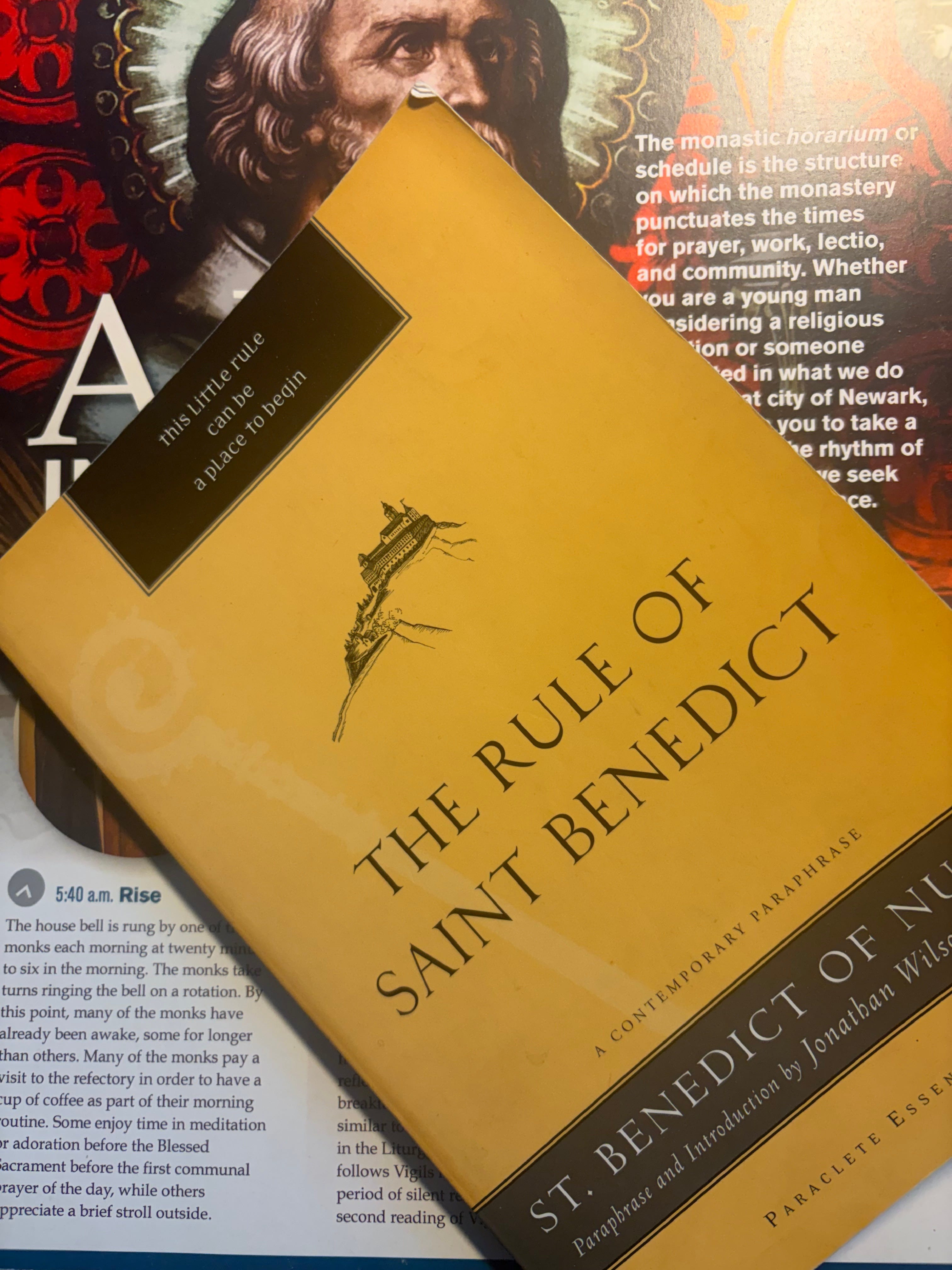
The Benedictine monks of Newark Abbey, like Benedictine monks the world over, follow The Rule of St. Benedict, the resilient, 1500-year-old set of guidelines laid out by Benedict himself. The tightly structured daily life of the monks follows a millennium-old pattern of prayer and work from early morning to the last moments of the monks’ day. Chapter 38 of The Rule prescribes the way that all the monks in a community stop their work at a certain time to eat together in a communal room, called the refectory. The monks eat in absolute silence, leaving space in their hearts and minds for prayer. While the body is nourished, the mind is fortified as one of the monks reads aloud from a book, often the lives of the saints, or another selected by the abbot.
The abbot of Newark Abbey, Augustine J. Curley, is a historian by training. He attended the abbey school, St. Benedict’s Prep, in the early 1970s, just before it suspended operations, and thus was forced to finish up at rival St. Peter’s Prep. After taking his vows, he returned to Newark, and he’s been there since. He was especially welcoming and helpful to me as I was researching On This Ground, and when book was published a few weeks ago, he decided that it should be read during the evening meal. The monks take turns reading every night, each one manning the microphone for a week at a time while the others eat. One day, the abbot invited me to come in to read from my own book, and I jumped at the chance.
I’m not quite sure why I did. I already knew enough about Benedictine life and The Rule to know that I would be reading to a bunch of men while they were eating, the uncomfortable equivalent of being the after-dinner speaker who’s at the dais when the sheet cake and coffee are still being served. While I wouldn’t have to fight to be heard over them talking because they would be absolutely silent throughout, I knew that it wouldn’t end like other readings with questions, accolades, or requests to sign books, all the customary self-satisfying dividends of this type of literary function.
The monks’ silence allows them to hear God. Mine is not so acute, but I have learned how to listen to others’ dreams.
It might simply have been the uniqueness of the opportunity that made it too hard to pass up. But, I’ll be honest, there was more. I thought of the reasons why the monks eat in silence. According to The Rule, there should be silence during the meal “so that no whispering can be heard, nor any voice except the reader’s.” That puts an end to gossip and negative thoughts. It also leaves room for grace and empathy, and opens a path for greater understanding. What writer could ask for more than that? I also identified with that silence. The very first word in The Rule is “Listen,” and listening—truly listening to what others are saying, or are not saying—is one of the most important skills a journalist possesses. The monks’ silence allows them to hear God. Mine is not so acute, but I have learned how to listen to others’ dreams.
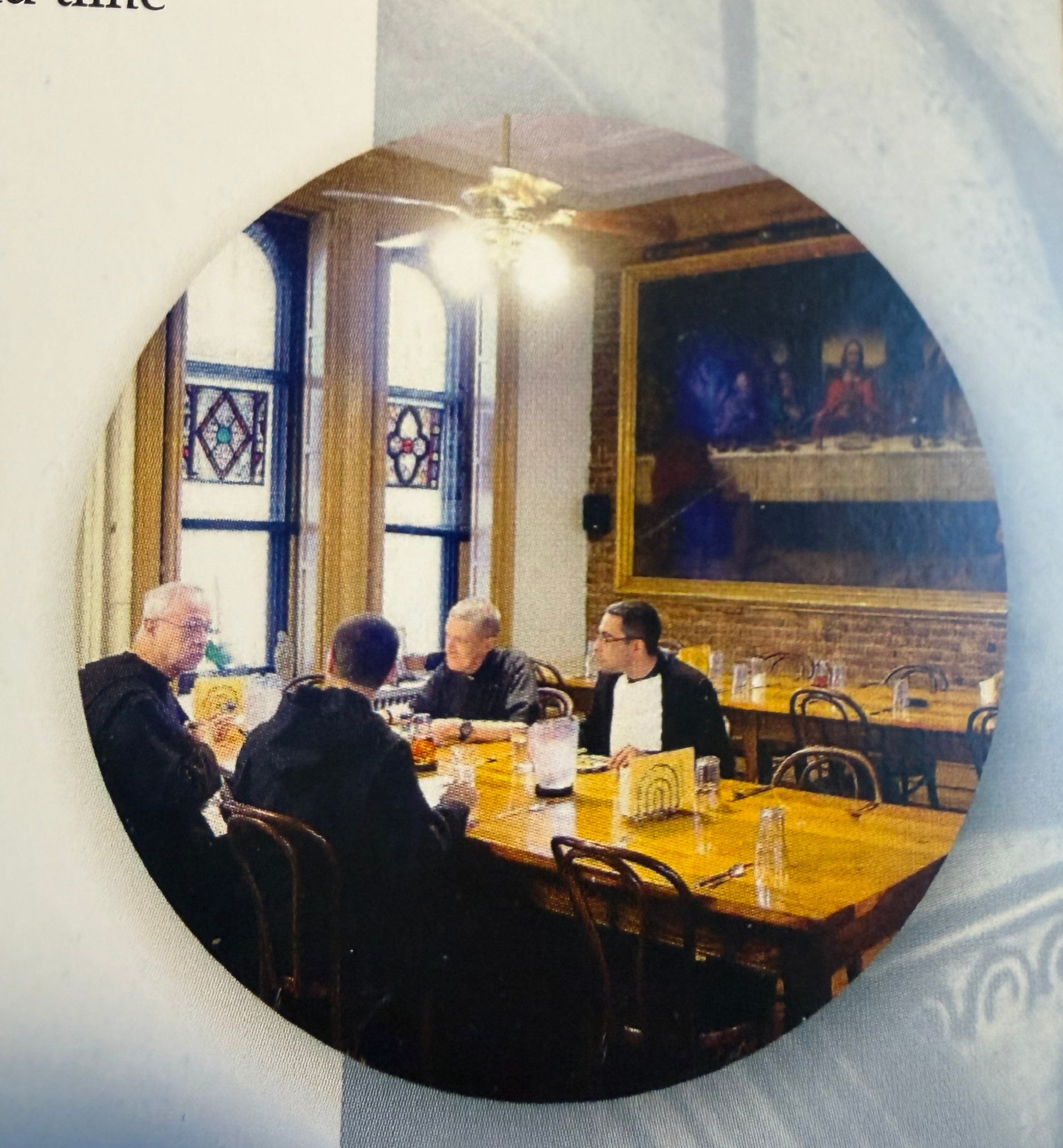
On the night I was to read, I met Abbot Augustine in the lobby that connects the monastery and the school, and he escorted me inside. The refectory is a large room at the center of the monastery with a smooth wooden floor and a huge painting of the Last Supper on the wall behind the abbot’s seat. Eight long tables run parallel to the painting, with simple wooden chairs stationed along each one. The abbot quickly ran down the order of things, showing me where I’d sit, and where to pick up the reading (Chapter 17, top of page 188). At 6 pm exactly, the monks recited a prayer, silently served themselves from cafeteria-style warming trays (a braised pork chop, boiled potatoes, cabbage) and returned to their seats. Father Mark Dilone, the designated reader that week, then sat before the microphone, read another prayer, a section of The Rule (Chapter 59), and a brief memorial to two deceased monks from the community. Then he left the mic to me.
As the abbot had instructed, I began by reciting the title and author, struck immediately by the oddity of pronouncing my own name into the mic, as if for those few moments at the mic I was not myself but, as custom demanded, a member of the community, and that, frankly, was something outside my wheelhouse. I’ve been a journalist my entire adult life, starting back when I was in my second year of college. I have always taken seriously the now somewhat outdated notions of “objectivity,” fairness, and independence, hoping to keep my own passions and prejudices out of anything I wrote. Doing so has meant distancing myself from anything that might interfere with that objectivity. I never joined any club or pledged any organization. I didn’t even join the Newspaper Guild—the labor union representing New York Times journalists—although I was forced to pay dues. I never wanted to be in a position of writing about a labor dispute and feeling pulled to one side or the other because of my own experiences.
Journalism allowed me to immerse myself in the lives of so many people in the communities and countries that I have written about, giving voice to their dreams and passions. But to do so, I have always remained an outsider, looking in from afar but never joining, never becoming one of them. I have lived through my writing, and it has been fulfilling.
But it has also taken a toll on my own sense of who I am and where I belong. I’ve never worn a uniform (once past Cub Scouts) or belonged to a team (after high school track). I reluctantly registered with a political party because it was the only way under the existing rules for me to participate in primary elections. In all the years we’ve lived in our house, our front lawn has never borne a virtue-signalling sign for any cause or movement.
Sometimes I worry about the effect all that self-restraint has had on my wife and our children. After seeing me refrain from getting involved in anything outside my work for so many years, did I reinforce the notion that they should do the same? Have I unwittingly goaded them into the same kind of isolation? Have I damaged them beyond repair?
Now that I am in this later stages of my career, working as an author who also happens to be an independent journalist, I’ve tried to loosen up. I still won’t put a sign on the lawn, and my library card is as close to a membership i.d. as I tuck into my wallet. But I sometimes allow myself to feel part of a community. I have attended a handful of meetings with local council members, and I’ve been to neighbors’ houses to meet local candidates, although the transition from reporter to stakeholder is still a challenge.
Add to that list my decision to accept the invitation to read my own book during the monks’ silent dinner at Newark Abbey. Ironically, the section I read detailed the dark night of the soul of a St. Benedict’s alumnus I profiled in the book. His descent into the drug underworld was a far cry from the life of a saint, but the story fit because the alum eventually redeemed himself, with the help of the training and preparation he’d received at St. Benedict’s.
After I’d been reading for twenty minutes, I looked up from the pages of my book and noticed the abbot giving me the sign to wrap it up. When I got to the end of a paragraph, I marked the book so Father Mark would know where to pick up the next day, and I let the abbot know I was done. The monks stood for a concluding prayer and then a bell was rung, signalling the end of dinner, the end of the imposed silence.
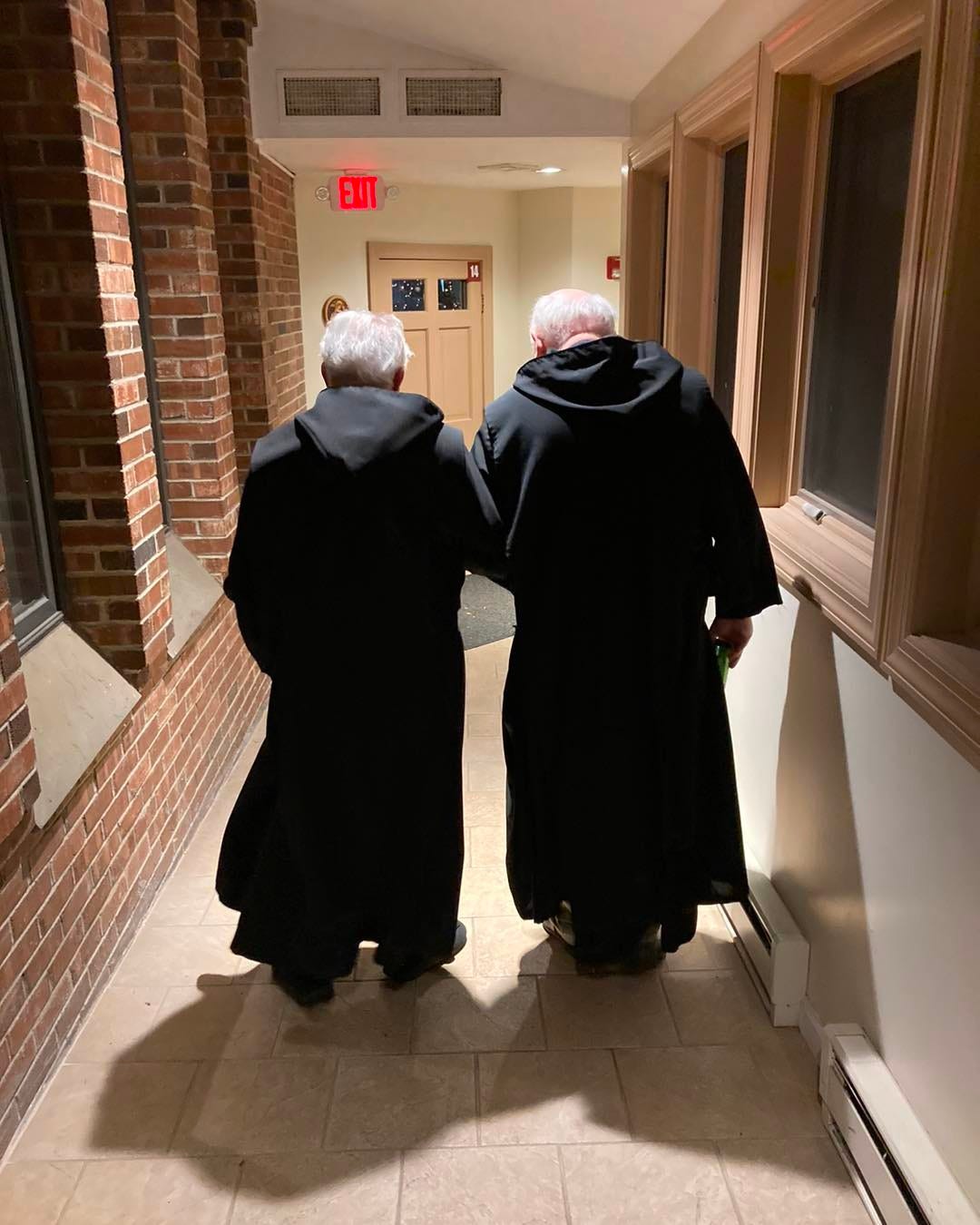
The 13 monks, some with their canes and walkers, had about 15 minutes before they would be called back to the adjoining church for the start of evening vespers. Most quickly shuffled out of the refectory, but a few stayed behind to thank me. It was rewarding in a way that no book-selling event could be. Not one book was sold. Not one autograph signed. There was no applause, no laudatory praise for me or my words.
And I was happy.
Your essay is almost haunting in its cadence. Your line "Mine is not so acute, but I have learned how to listen to others’ dreams", reinforces my intention to take moments of quiet (not just silence) several times each day.
Thank you...
You are so right Mr McGuire. The monks often do not see it as an imposed silence but a welcomed respite, one that I sometimes harbor the hope of finding.