
The Holy Ghost Generation
What do you do when even your core changes?

Substack #028
One of the most remarkable things about Abbot Melvin J. Valvano, the recently deceased Benedictine priest from Newark Abbey I wrote about last week, was the resilience of the faith that carried him through his long life despite cosmic changes in the society he lived in, the city that he vowed to die in, and the very religion that was at the core of his existence.
Abbot Melvin belonged to what I think of as the Holy Ghost Generation of Catholics, people who, like me and so many of my family and friends, were raised in the pre-Vatican II era when Catholicism was practiced in a way that more resembled the 12th century than it did the 21st.

You don’t have to be Catholic to know about the disruptive changes that have taken place inside those big old Catholic churches in old America cities like Newark, Hoboken, and so many others. The ceremony of the mass, the ritualistic heart of Catholic belief, was radically changed. During our childhood and for centuries before, mass had always been said in Latin. We all were accustomed to the sound of Latin, even if we didn’t understand most of it.
But during the Second Vatican Ecumenical Council in the early 1960s, the rules were changed so that masses were to be said in the local vernacular. Here in the United States, that meant mass was in English. I’ve attended masses in Mexico where the prayers of both the priests and the people were in Spanish. In Italy, they were in Italian. I’ve even been to Catholic masses in Nunavut, inside Canada’s Arctic Circle, where prayers were said in Inuktitut, the language of the indigenous people there.

For the Holy Ghost Generation, the mass looked like this
Changing from Latin to English transformed the Catholic experience and upended centuries of tradition. It’s as if Muslims had decided to modernize by giving up Arabic. Or like Jews abandoning Hebrew so they could seem more contemporary. When I was a foreign correspondent, attending mass in places I’d gone to was a way of grounding myself. Everything around could be foreign, but going to mass was a way of reminding myself that I was still the same person. But if I didn’t speak the local language, it was disorienting to find these fundamental prayers and ceremonies changed so radically that I felt like an outsider.
Latin had always reinforced the basic ideas we had learned in our catechisms. Some of the words were incomprehensible, but belief was based on faith, not understanding. But when we repeated prayers like the Nicene Creed in English, we had to come to grips with the reality of what those beliefs actually entailed. And that has made being a Catholic much more of a test of faith. As questions arose, I found that answers are few. I was left with the explanation I once read of why an eminent philosopher still held on to the same confounding catholic beliefs: I can’t help it, she said. That’s the way I was raised.
In addition to dropping Latin, the basic choreography of the Catholic mass itself was radically reimagined. After many centuries when the priest faced the tabernacle and had his back to the people, he (still always he) now is turned around and addresses the faithful face to face.

With the revised orientation of the new mass, we see more but don’t necessarily understand more
I’m not passing and broad judgment here on whether the changes have been good for the Church and its people. But what happened was the undoing of more than a millennium of religious practice, the kind of deep, profound change that can be challenging for even believers to accommodate. At least here in the United States, we live with a paler version of Catholicism, with fewer religious, fewer Catholic schools and hospitals, and fewer practicing Catholics.
There were many other aspects of the sweeping reforms of Vatican II that upended the most ingrained aspects of Catholic life and the most traditional of Catholic practices. I’m certain that when Melvin was a student at St. Benedict’s in the 1950s, he could not have imagined any of them because neither could I.
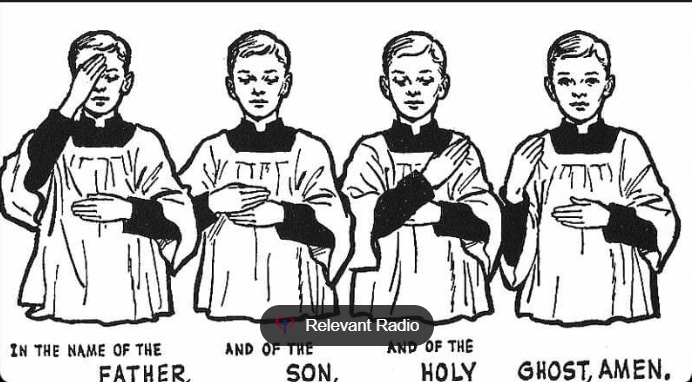
Back then, there were church prayers and home prayers, the ones we were expected to repeat every morning and night. We said those home prayers in English, each session starting with the sign of the cross. The sign was an elementary motion we learned before we were ten, and that we were expected to repeat countless times on countless days from then on until the day we died. But even that changed. Where Abbot Melvin and I and countless others were taught to say, “In the name of the Father, and of the son, and of the Holy Ghost, Amen,” the Vatican II reforms changed Holy Ghost to the less vernacular, and only slightly less spooky, Holy Spirit.
Still, even now, if I’m not paying strict attention, the Holy Ghost steals back into its old place when I make the Sign of the Cross.
Outside of the English mass, and the accompanying change in musical tastes from Gregorian chants to New-Age, guitar-strumming, politically-correct, hymns shorn of offending gender references, along with felt banners, taking the communion host in your hands instead of on your tongue, and the awkward open-air, conversational confessions, Catholic culture changed. Meatless Fridays, a deeply ingrained tradition in our crowded household that my mother appreciated because it imposed strict meal requirements on at least that one day of the week, easing one of the burdens of running a three-generation household, all mostly went by the wayside, along with many fasting and abstention obligations that shaped our childhoods.
One of the most sweeping effects of the reforms was the impact they had on priests, nuns and brothers, who left in droves, triggering vast changes in Catholic education. When I started high school at St. Joseph’s in West New York in 1966, all my classes but one were taught by Christian Brothers. By the time I graduated, most of my teachers were laymen. The St. Benedict’s Prep that Melvin attended was chockablock with monks, men he and many other students so admired they made the decision as teenagers to follow their example and join the order.
But I think that the biggest change that Melvin had to contend during his life with had nothing to do with Vatican II. Several decades after he entered the priesthood, men like him were routinely viewed with suspicion that sometimes was combined with revulsion, sometimes with anger. Though his faith remained strong, the pedophilia scandals that tore at Catholic foundations at the outset of the 21st century eroded faith in the priesthood, pushing many Catholics to turn their backs on the church. The scandals have brushed Newark Abbey, but they did not touch Melvin or the corps of brothers who with him rebuilt and ran St. Benedict’s.
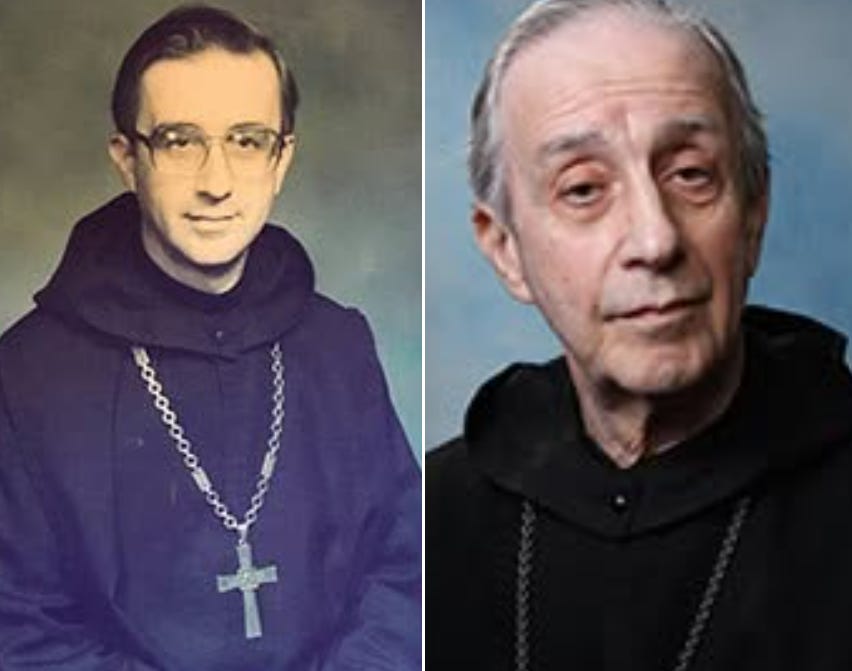
Even within the stable community of Benedictines, Abbot Melvin displayed uncommon resilience
Despite the magnitude of the changes around them, Melvin and the Holy Ghost Generation monks at Newark Abbey adapted to all the changes, fought off all the suspicions, and remained faithful to their vows, which, as Benedictines, includes a vow of stability to the community in which they pray and work. I don’t know if the fact that the turmoil in the church coincided with racial unrest of the 1960s in Newark and other cities made it harder or easier for these guys to stay the course, but whatever the reasons—and only they know why—they did. And once they dedicated themselves to the resurrection of St. Benedict’s after it closed in 1972, they have continued to bear the burden and move forward.
Inevitably, time and nature are taking their toll. Abbot Melvin was 87 when he died last month. Several of his Holy Ghost Generation brothers in the monastery are also in their 80s or close to it. There are a number of much younger monks in the monastery now (call them the Generation of the Holy Spirit) giving Newark Abbey hope for the future. But decades went by without any new members entering the monastery, leaving a gap between the Holy Ghost generation and the rest that will never be bridged.
The Vatican II changes were called an aggiornamiento, a renewal or a bringing up to date of the church’s millennia-old relationship with the modern world. Of course, that modern world has changed many times over since the Ecumenical Council opened in 1962. By then, Melvin had already made his profession as a monk in the abbey church on what used to be High Street in Newark. That church, St. Mary’s, built in the 1857 still stands, but during Abbot Melvin’s long tenure he approved an overhaul to accommodate the new people-facing altar, the new lecterns for lay readers, as well as spaces for guitars, drums and other modern instruments concessions.
During the years I was reporting on St. Benedict’s for my book, I watched Abbot Melvin sitting off to the side during mass in St. Mary’s. He was too frail to concelebrate with the other monks. One of his brother priests would carry a host to him during communion and place it in his unsteady upturned palm. I sometimes wondered what was going through his aged mind as he struggled to comprehend all that had changed in just his lifetime. As a Benedictine, he was accustomed to stability. As part of a community that has survived for 1500 years, he was no stranger to adversity. And like the rest of us members of the Holy Ghost generation, he may have felt the rug slip beneath his feet, though he, for one, remained steady and never, as far as I can tell, lost his footing.
It seemed to be a foundation back then . Eventually we come to see the world differently, even if those early experiences stick to our consciousness.
Yes change over the life time.... but the foundation of faith remained... facing the back or front of the church does not change its foundation.... thank you for sharing this moving writing so greatly appreciate by one who left the church and the religion, but not the spiritual foundation... a Jersey Tough Guy