
The Life We Plan
And the Life That's Waiting For Us

StandFast #030
It’s a true and lasting joy to listen to young children talk about their future and to see the hope in their eyes as they describe all the fantastic things they plan to do with their lives. We encourage the ones who lay out complicated, even contradictory, ideas for the way they want their long lives to play out. And we console the ones who say they don’t know what they want to do, helping them conjure up endless possibilities, with only the slightest silent worry (depending on their age) that they will never figure it out.
Sooner or later, all of them will find out what happens to the plans we make. The dreams that early on seem so real can turn without warning when, out of nowhere, some deus ex machina roars up to scramble time, place, and people so dastardly that what it leaves behind bears almost no resemblance to those deliciously imagined plans.
That’s why stopping an old friend you haven’t seen for a long time to ask what they’ve been up to can be such a sad experience. Plans, wrecked or abandoned, mutilated by necessity or made obsolete by unforeseen influences, can look pitiful from this angle, hindsight revealing what never was truly possible. Inflated expectations, exaggerated estimates of time, talent and energy, even the unjust sentencing of biology that can dictate our destiny, all conspire to knock our plans to the trash heap.

That’s where resilience comes in. The classic definition of resilience, as per the American Psychological Association, is “the process and outcome of successfully adapting to difficult or challenging life experiences, especially through mental, emotional, and behavioral flexibility.” Where does this power come from, and, more importantly, why are some people so resilient while others are complacent? It’s an important enough question for Harvard’s Graduate School of Education to have studied and come up with an answer. Resilience, according to Harvard, “is born from the interplay between internal disposition and external experience. It derives from supportive relationships, adaptive capacities, and positive experiences” that resilient people have, and that more easy-going people do not.
I take that to mean we don’t do it alone. Resilience is a kind of teamwork where our individual actions, combined with our own fortitude and character, are strengthened by the people we choose to have around us and who we lean on when we are forced to adapt. And possessing the aptitude for adaptation is key, especially when it comes to how we shape our lives.
The great moral philosopher Joseph Campbell understood this in a critical way. In Diane K. Osbon’s “Reflections on the Art of Living: A Joseph Campbell Companion,” she records one of Campbell’s insightful notes to self.
“We must be willing to get rid of
the life we’ve planned, so as to have
the life that is waiting for us.”
In other words, she has Campbell explaining, “The old skin has to be shed
before the new one can come.”
Who knows how many of us have had a childhood dream that we’ve managed to pursue for a short time or, for a chosen few, our entire careers. I looked for hard data on this, but it is hard to come by. I did run across one interesting survey. It’s small, so who knows how accurately it describes this mixed-up, crazy world we inhabit today. But the results track what I have suspected all along.
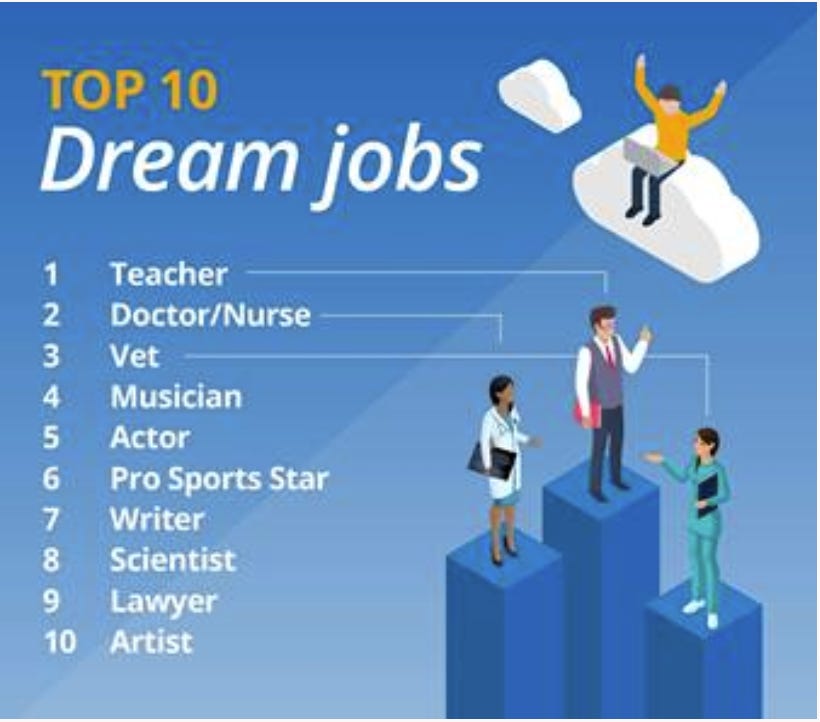
Graphic by Ladder, Inc.
It’s a survey of about 2,000 people conducted by the placement firm Ladders, Inc. and published in the pre-COVID winter of 2019. (https://www.theladders.com/career-advice/did-you-end-up-being-what-you-wanted-to-be-when-you-grew-up) The headline covers it all: “Only Ten Percent of People are in Their Childhood Dream Job.” That’s 200 out of the 2,000 people surveyed, and that’s in line with what experience tells me is true. The family I grew up in didn’t really have the freedom to pursue childhood dreams. Just surviving and thinking about getting ahead—however you could manage it—was all that mattered. I turned out to be the odd exception. The written word has been my passion for as long as I can remember, and it is all I have ever done.
But not so for my parents or my five brothers and sisters. Nor for my children, my relatives, and most of those in my circle of friends, with the exception of one career firefighter who latched onto the dangerous thrill of fighting fire as a young man and stayed with it until forced retirement. He’s now babysitting his grands.
And there is one other exception, a hard-to-place outlier who is neither family nor friend in the classical sense. I’ve written about him before, and dedicated my last book to him. Brother David Van Hollebecke just celebrated the 75th anniversary of his taking the habit as a brother of the Christian Schools. He was the kick-ass vice principal and patient teacher of geometry and algebra at St. Joseph’s Boys High School during my time there from 1966 to 1970.
Brother David (the second son of a hardworking Detroit butcher who gave him the oh-so-fitting name Ernest) told me that he made his decision to enter the religious life when he was just 16 years old. His older brother had attended a highi school taught by the Christian Brothers and came home with so many stories about the guys in black robes and starched white collars in the shape of the ten commandments that young Ernie couldn’t wait to enter the same high school Once he got there, he watched the brothers handle the large classrooms of teenagers, he listened to them telling stories of the adventures they’d been on—some of them missionaries, all of them teachers—and by the time he was only half way through high school, he’d made up his mind to join their community.
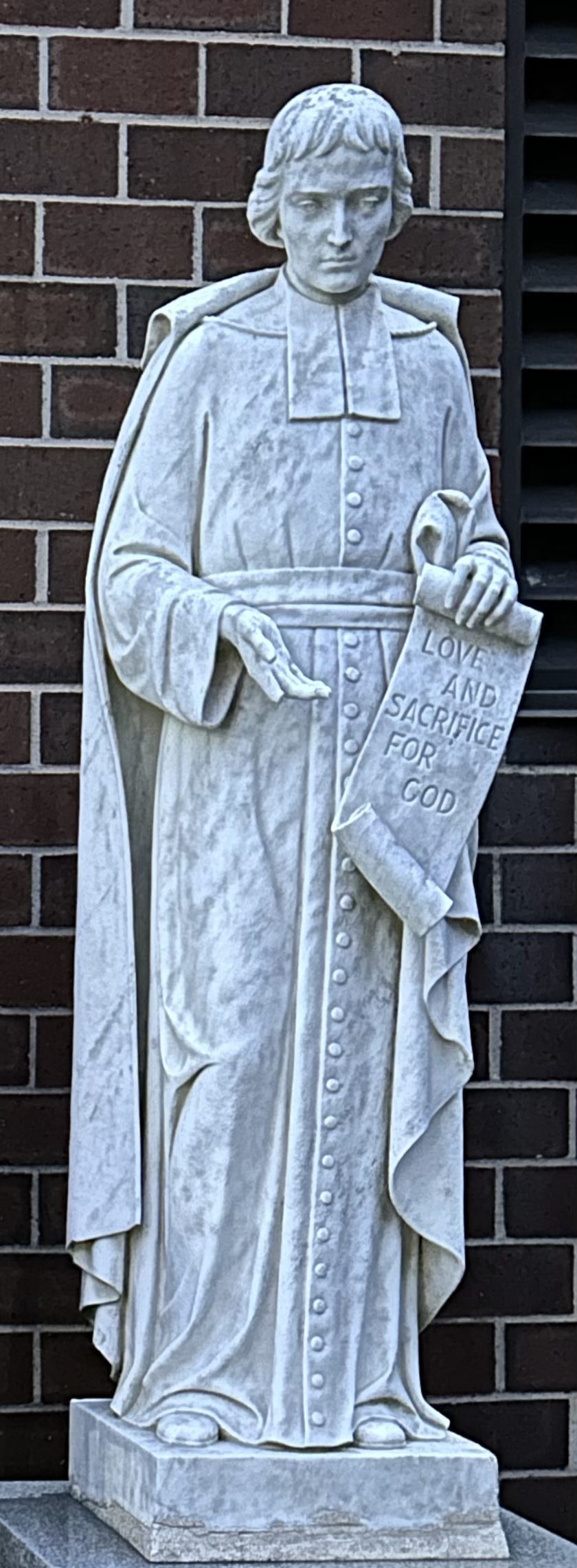
St. Jean Baptiste de la Salle, founder of the Christian Brothers
Ernie’s mother didn’t approve, but neither did she stand in his way. Did she know something then about him and his vocation? Or about his faith? Two years after deciding to become a brother and completing his studies, he entered the order. He was just 18 then. Could his mother, or even he, have had any idea that 75 years later he’d still be a brother?
He’s now 93, living out his life at the Christian Brothers retirement home in central New Jersey. I call him as often as I can to check up on him, and recently arranged to visit with a couple of tough Jersey guys who also attended St. Joe’s when David was the vice principal. The giant in a black robe that I remember is now restricted to a wheelchair. He wears a floppy hat to keep the sun off the dangerous growths on his nose and face that his doctors have tried to remove. We had pizza on the patio and talked openly about our lives. He told us repeatedly that he had no regrets about joining the Brothers and sticking with it for so long.
We, his former students, had families, varied careers and interests, and our lives had been filled with innumerable challenges and unanticipated obstacles. By comparison, his life had been orderly, programmed by higher-ups. As a brother, he told us, he followed orders—about where to teach, what to teach, where to live. He has dedicated his life to teaching the undeserving, often unappreciative, young men like the unruly bunch we were so many years ago. And like the Benedictines in Newark I’ve written about, he was devoted to his own community of religious brothers.
I know he also devotedly took care of his mother, bringing her to a nursing home in the Bronx, sharing the New York Times and an afternoon nip with her whenever he could. I know he took the same devoted care of his sister, who never married, until the day she died. He’s now close to his nephews and nieces who visit whenever they can.
I suppose you could say that we—David and I—are alike in that we both early on made our decisions about how to spend all the precious days of our life. But my path was provisional, and serendipitous. There was no writer’s robe to attain, no journalist’s vow to bind me, no author’s fraternity to commit to for the remainder of my life. I could have veered off at any moment with no consequences except to my own ego. By contrast, David’s commitment was a public avowal, attended to by witnesses, given the imprimatur of the Church, attested to daily by the restricted life he lives to this day.
That same survey by Ladders, Inc. that I mentioned above found that a quarter of the people surveyed reported having actually had their childhood job for a time but not sticking with it. And about 40 percent regretted giving up on their dreams.
Which brings me back to that classic definition of resilience, that interplay between the core of our own being and all that the world throws at us. The list of the top ten dream jobs that people in the survey identified was loaded down with public service jobs, the kind that children are most impressed with. The top three in the survey were teacher, doctor, and vet, the kind of people children would have the strongest emotional attachment to, and therefore the strongest desire to emulate, just as what happened to young Ernie.
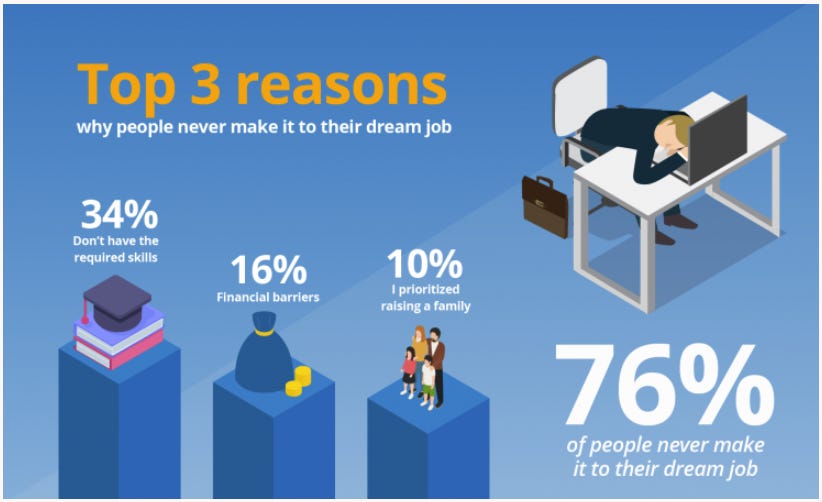
Graphic by Ladder, Inc.
The survey also grouped respondents by age, which provides some insight into the way our society has changed. Teachers and doctors topped the list of all the age groups surveyed. But only the oldest people surveyed had included writer/ author in their list of childhood dream jobs. Lawyers have also dropped off the list, with both being replaced in the younger respondents’ lists by musician, actor and e-sport player.
However that turns out (and we can only hope that all those e-sport dreamers find something else that interests them), the reasons given for abandoning those dreams will probably not change dramatically. According to the survey, among the people who never got to hold their dream job even temporarily, a third said it was because they never managed to get the proper training. Another 16 percent gave financial reasons for abandoning their dreams. The rest said they put raising a family ahead of doing what they really wanted to do.
The vocational model that brought Ernie Van Hollebecke into the Christian Brothers has gone belly up. At the time I met Brother David in 1966, the Christian Brothers were at their all-time peak, with about 18,000 members around the world, 4,000 of them in the United States. Today, they number no more than 3,000 globally, and here in the U.S. the community has shrunk to fewer than 500, many of them elderly and no longer active. As the number of Christian Brothers shrank after Vatican II, fewer young men in those schools were exposed to the Brothers’ way of life. That meant fewer young men were attracted to that way of life, and left even fewer men to stand as models for others. Like the Sisters of Charity and other venerable religious orders, the Christian Brothers in the United States may be on a “path to completion” where they simply stop accepting young men into a community whose days are numbered.
But there will be plenty of video gamers, cultural influencers and recording artists—real or AI-generated—to offer models for the young to dream about, then pursue and most probably abandon, before they shed that particular skin and find a new one.