
A Downtown Monk
Abbot Melvin J. Valvano Shepherded His Flock Through Newark's Darkest Days

StandFast #027
When he was elected abbot of Newark Abbey in 1973, the Rev. Melvin J. Valvano O.S.B. was only 35. That made him the youngest abbot in the history of the Benedictines in the United States. In a field that is, at least in general perception, usually associated with grey beards and hunched shoulders, he was a youthful anomaly. He continued to lead the abbey and oversee the extraordinary growth and success of St. Benedict’s Prep for 49 years—another Benedictine record—until he stepped down in 2022 and gently slipped into a monastic life of prayer, community, and graceful reflection.
This week, Newark Abbey bid farewell to the abbot, who died on June 28 and was buried yesterday at St. Mary’s cemetery in East Orange, taking his place alongside many of his Benedictine brothers of the last 150 years.
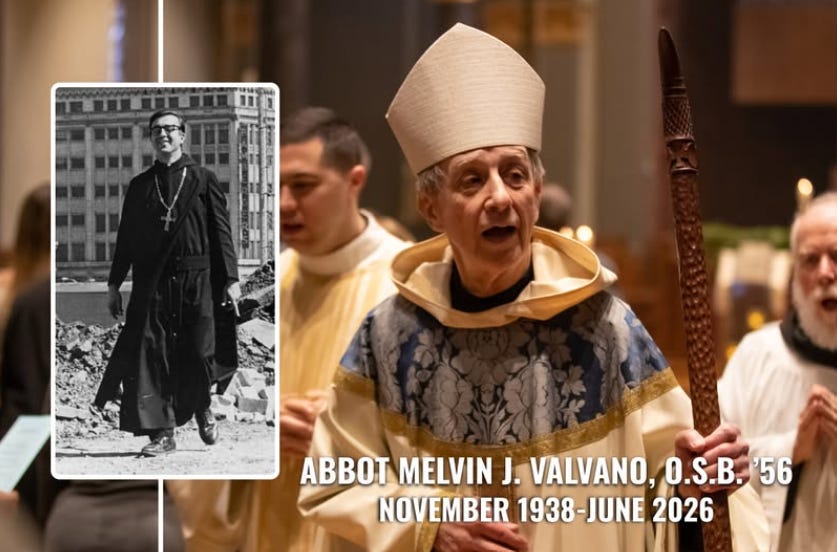
The abbot lived a long life of prayerful resilience and street-hardened courage. It was no easy task to be elected in September 1973 to run the monastic community that had just gone through such severe trauma. The monks had voted to close their beloved St. Benedict’s Prep at the end of the school year. Divisions within the monastery hardened, and half of the monks departed for St. Mary’s Abbey in Morristown.
Father Melvin and the others who stayed took jobs to replace the prep school tuition that had kept the abbey afloat.He worked as chaplain at the nearby V.A. hospital. Then, as the diehard monks regrouped, they reimagined what a prep school could be. They picked 26-year-old Fr. Edwin Leahy to run the school that hadn’t yet opened. And three days before the fall semester began, they elected 35-year-old Father Melvin abbot.
At that point, it was not at all certain that the school, the city, or the abbey would survive. Against all odds, Melvin brought stability to the monastery and vision to the prep school. He negotiated with Newark officials to purchase acres of the abandoned urban renewal land that surrounded the abbey, substantially brightening the outlook for the city’s devastated core. He oversaw the renovation of the adjoining St. Mary’s Church to accommodate the new people-facing altar introduced by the Second Vatican Council. He worked with financier Robert Brennan and MBNA bank founder Charles Cawley, both wealthy St. Benedict’s graduates from the pre-1972 closing, to rebuild, expand, and energize the school that Melvin himself had graduated from in 1956.
His 60-plus years of involvement with St. Benedict’s and the city of Newark are outstanding examples of resilience, true testaments to the kind of strength that comes from facing down adversity. I met him in 2001 when I first attempted to write the book that became “On This Ground.” The majority of monks voted to go along with the project, but Abbot Melvin was unwilling to give me, an outsider, the kind of full access I needed to write an independent book.
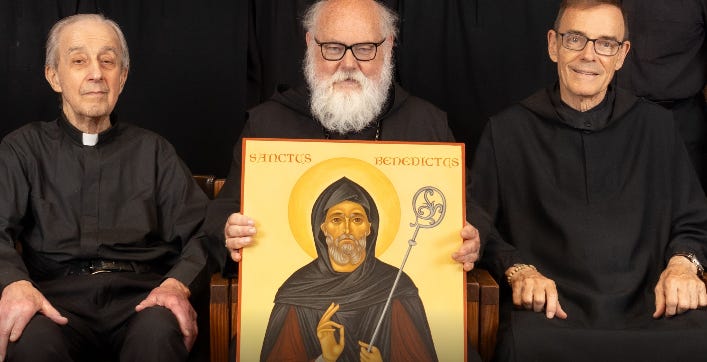
Abbot Emeritus Melvin, Abbot Augustine and Father Edwin
By the time I returned to the project in 2023, Melvin had stepped down and was replaced by Abbot Augustine J. Curley, a historian by training. Just as I had done in 2001, I pitched my project to the members of the monastic community arrayed in a semi-circle before me. Melvin sat just to my right. When I referred to resilience and bristlecone pine trees, I noticed a bemused look on his face, as if he was still trying to suss what I was up to. The monks again voted yes, and this time Abbot Augustine welcomed me into the community.
This week, I was at St. Mary’s when they brought in Abbot Melvin’s body for the traditional viewing. The old church was filled with people of all colors, and all ages. People who knew him much better than I did talked about the strength of his faith. They mentioned how, over the years, he had silently helped many students whose families struggled financially. One alumnus still marvelled at how the abbot had managed to teach him enough French to pass the course.
This was not the first death in the abbey since I’d started working on my book. The death in May 2024 of Fr. Maynard Nagengast had cast a pall over the monastery where he’d lived since the 1960s, and saddened the school, where many teachers and administrative staff knew and respected him. But like Abbot Melvin, Fr. Maynard’s death had not been unexpected. He’d been ailing for a number of years, and it was only when he needed round-the-clock care that the monks called in outside help. These monks do not have a retirement home the way other religious orders do. In fact, monks don’t ever retire. Since the Rule of St. Benedict doesn’t allow them to identify with any job, they simply stop doing one thing, and switch to another inside the same abbey where they remain, until death.
Following a funeral mass, I followed as Father Maynard’s coffin was taken to St. Mary’s cemetery in East Orange, marking another solemn phase of the monks’ vow of stability. Under a splendid flowering dogwood tree in the center of the cemetery, the legacy of the Benedictine spirit is embodied in the grave markers of monks going back to the very first abbot, James Zilliox, and his family.
Standing in the cemetery in May of 2024, reading the names of those monks who formed the foundations of St. Benedict’s past, it felt to me like opening a family keepsake chest and recognizing hereditary links to the past. The dozen monks at graveside for the internment, including Abbot Augustine and Fathers Edwin, Albert, Philip, and others so long connected to St. Benedict’s, as well as young Brothers Robert and Bruno, all profess the same faith--that death is the welcomed transition to eternal life. I noticed Brother Robert standing quietly, with the pointed hood of his black robe, called a cuculla, drawn over his head. After the service ended, I asked him what he’d been feeling. He said he was at peace with the idea of spending the remaining years of his life with the monks at Newark Abbey, and ending his earthly journey in this same piece of ground, under that same flowering dogwood.
I recently ran into Brother Robert at the Essex County Courthouse, just a block from St. Benedict’s and Newark Abbey, when we both were called in for jury duty. I’ve gotten to know and like Robert, who came to the U.S. from Mexico. Two years ago, he’d invited me to join his Mexican family at the ceremony where he took solmn vows and pledged to spend the rest of his life as a monk at Newark Abbey.
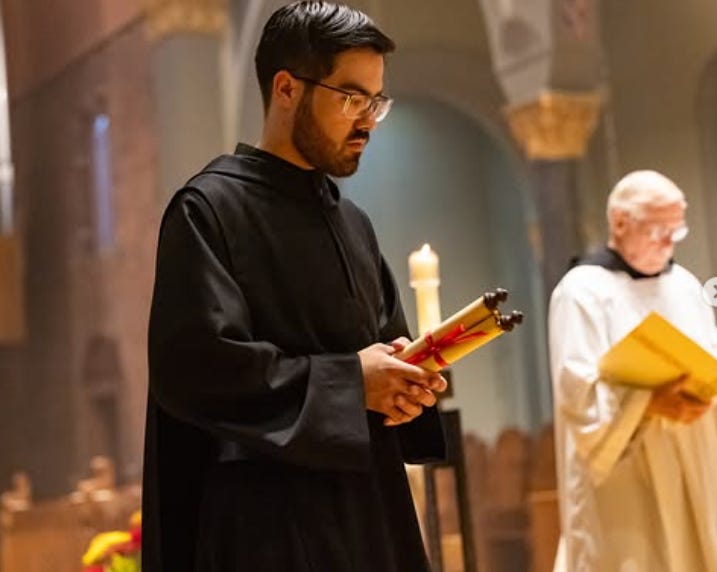
“Stability in this community” is written on the vows in Brother Robert’s hands
As we waited in the courthouse to be screened for jury duty on a criminal trial, he told me that although he looked forward to serving on a jury because it was unheard of in his native Mexico, he wouldn’t be able to do so this time because he needed to be at the abbey for Abbot Melvin’s funeral and interment.
Robert told me that he had sat with Melvin just a day before he died, and could tell that he was at peace. Melvin was 87. Robert is 29. He then essentially repeated to me what he had said at the cemetery two years earlier. The thought of someday being in the same position as Melvin, in the same city, with the same final destination of St. Mary’s cemetery in his hopefully far distant future, did not bother him at all.
At that moment, I envied him for the degree of certainty he possessed about his future. I knew that there was no guarantee he’d stay the course for as long as Melvin had, or even whether Newark Abbey itself would manage to survive long enough for Robert to grow old.
When he was Robert’s age, Melvin could not have foreseen the future that awaited him, for there were titanic changes heading his way, changes that would challenge the core of his life and the lives of so many others. More on that next week.
R’ Triquet, I didn’t get to know Abbot Melvin well but I understand and appreciate what you must have felt as a young man in their presence for even one year. You were lucky to have been there to experience that time, and the impact it has had on you shows these many years later. Thank you for writing. I appreciate hearing from you.
Thank you for this tribute to Abbot Melvin.He had a huge influence on me, as he has had on so many.He is greatly missed.We shall carry him with us.
Greg Thornton
SBP, Class of 1967