
In The Wee Small Hours
What the Past Reveals

SF #009
Not long ago, I was surprised to find an unexpected package at our doorstep. It was the familiar size of a box of letterhead, and when I removed the wrapping that, in fact, is what it was. Inside the box was the real surprise, an astonishing and timeless gift from Patrick M.
I’ve written before about how I knew the Patrick M. in my gang of tough Jersey guys practically my entire life: Same town. Same clean-up position at the tail end of big Catholic families (I was fifth of six, but he was eleventh of thirteen!) Same Catholic grammar school. Same Catholic high school. Same madness for words.
That said, we were opposites in many ways. My dad was a longshoreman, his father worked in City Hall, the director of Public Works. Patrick was a sweet-tongued and irrepressible raconteur. I tended toward taciturn, except when I was with him and I tried desperately to keep up with his erudite chatter. Just being close to him made me feel different. One afternoon, on the way back from St. Joe’s, we missed the bus and just kept walking, and talking, so deep in conversation that we walked all the way home. That was 2.3 miles for him. Three point three for me.
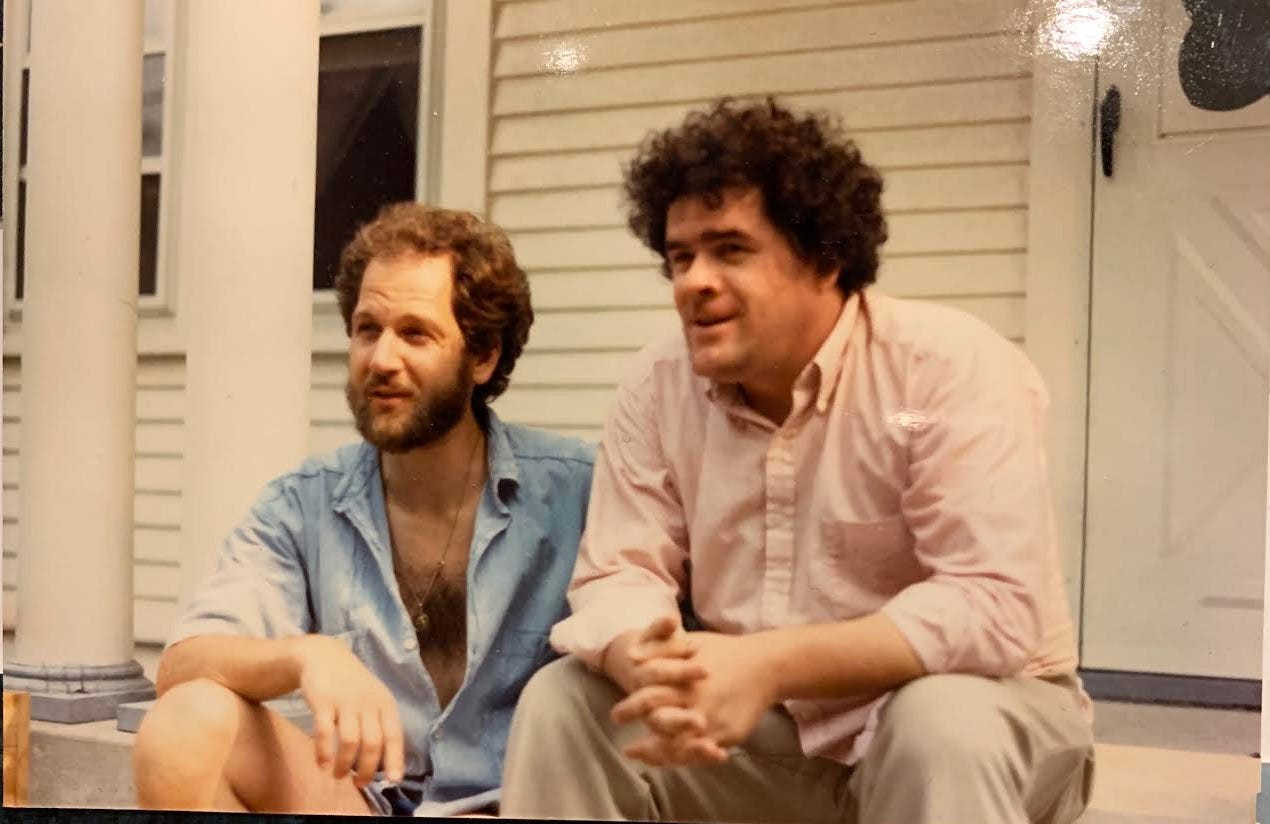
I picked him to run for Student Council with me, and we won. In our senior year at St. Joe’s, I was president and he was vice president, two kids from Hoboken leading the way. I drove him to school in my ‘63 Chevy Impala, and sometimes had to go into his family’s joyously boisterous house to rouse him from the nest of his sibling as they sat around a farm table that took up the entire room.
I can vividly recall a fleeting image of his father rushing around town, his trench coat flapping, as he leaned into an early evening dusk. His noisy Irish wake was the first one I attended as an adult, my introduction to the reality of getting older.
After St. Joe’s, we went our separate ways. He was a New Yorker at heart, a graduate of Fordham’s Lincoln Center campus, followed by grad school at NYU. We both married early, although his first didn’t last long. Miriam and I married a week after I graduated from Seton Hall, and soon after moved to Trenton where I worked at a Public TV station. But writing was my passion, and I signed up for a fiction class at The New School in Greenwich Village. That meant taking the train to Newark, then a subway to the village.
“There wasn’t time for me to jump off, or for him to jump on.”
I was on one of those subway cars passing through Exchange Place in Jersey city one night when I looked out the window and saw him standing on the platform. He gave a hesitant wave as if he couldn’t trust his eyes. We hadn’t seen each other in several years. There wasn’t time for me to jump off, or for him to jump on. I don’t remember how I found him in those pre-internet days, but I did. He was on his second marriage, working at NYU while pursuing his PhD. We both agreed that our chance encounter was way too melodramatic to be included in the short stories and novels we were feverishly trying to write, but neither were we willing to ignore how the unvierse had brought us back together. Kharma was the word he used, letting it ooze from his lips. Kharma.
Soon after our chance encounter he moved to Kenosha, where his new wife Anna’s family was well established. We began a long distance relationship, highlighted by occasional visits—he brought is own brood of five here, we hauled our three there. But the real juice of the relationship was sharing writing projects. He remained a dreamer, constantly erupting with lovely phrases, vivid word pictures, novel plots. He never completed the dissertation that would have gotten him a PhD and a tenured position at the local branch of the University of Wisconsin. Instead, he spent 30 plus years there as a lecturer, growing into a larger-than-life personality perpetualy cloaked in black. His hair grew long and his waist more than doubled as he tried on a character of his own design, the puckish professor who wandered the campus alterately spouting Yeats and faithfully reciting lines from The Godfather, often in character. He was amazing, fearfully clever, achingly erudite, funny as hell. An hour with him was high entertainment, a privilege sought by many, and guarded jealously by all.
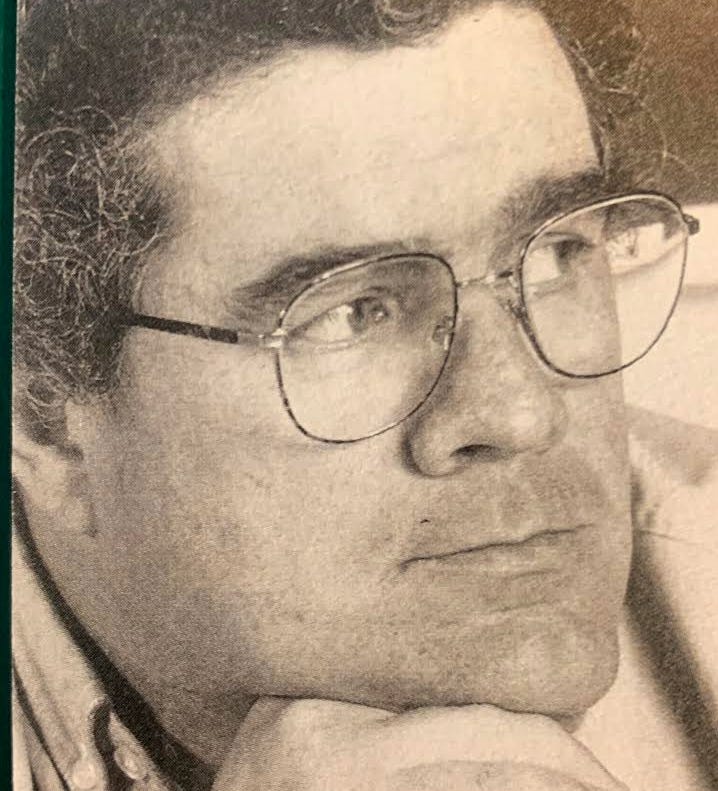
I went in a different direction, finding unexpected success in journalism, mostly serious stuff, while the pages of five unpublished novels and countless short stories collected dust in my closet, never seeing the light of print. Charm remained an aspiration. My voice, chained to journalistic conventionstyle, leaned toward prosy more than poetry, and I remained hopeless at reciting any literary or cinemativ line from memory. I was too focused on what was happening now, or about to happen tomorrow, to allow those lines from yesterday take root in my mind. Foolish me.
We encouraged each other, supported each other, argued with each other. He lent a critical eye to my failed attempts at fiction; I helped him get his own journlaism published. We planned to get together at our house in upstate New York for an extended stay of writing, editing, literary conversation and serious imbibing (he once spent a year searching out the perfect martini).
But first he and Anna took a long-planned trip to Scotland, where they had booked rooms in an ancient Scottish castle (so Patrick M.!) ) In postcards and a few social media posts he described the trip with heroic imagery, and I was overjoyed to know he and Anna were finally reaping the rewards of his decades in the classroom. They spent evenings on a balcony at the castle, gazing at the stars, a drink in one hand, a cigarette no doubt in the other. He was in his element, the kind of romantic bubble he might have conjured in one of his short stories (or the 500-page historical novel he improbably worked on but never finished about the life of Franz Schubert, composer of the Unfinished Symphony).
“his own dream world of enlightened stars peeking through the inky Scottish night”
The magic of that Highlands night prohibited him from doing anything as quotidian as going to bed at a decent hour. Poor Ana stayed with him as long as she could bear, then excused herself to retire for the night, waiting for him to come up when he’d had his fill. She waited and waited. When he didn’t show up, she went down to fetch him, thinking he might be serenading some new found friend with a soulful Sinatra, or was simply lost in his own dream world of enlightened stars peeking through the inky Scottish night.
As far as anyone knowns, he apparently had leaned back in his chair to better view the wonder of the sky, when the chair slipped and he fell backward hitting his head. The ensuing investigation found that he had been felled by a simple accident, compounded by his excessive girth. It took weeks for Scotland Yard to release the body so the family could fly Patrick back home. He was 67
I was in Kenosha for the wake, arriving to the funeral home to see a line snaking out the door and down the street. Here was a man who had forfeited ambition but championed passion. He had befriended the Kenosha community, and Kenosha had adopted him. Generations of students, cadres of friends and colleagues, multitudes of family and admirers, all showed up to bid an eloquent farewell to a man unlike any other they had ever known. Until I stood in front of him, he who I’d known since we were five years old, he who now was laid out in ruffled coffin, as big in death as he was in life, with a bottle of Jameson Irish whickey nestled in the crook of his arm, I couldn’t accept that he was gone.
Despite his deep spiritual devotion, which I had sometimes mistaken for religious fervor, there was no funeral, no Catholic rite of transition. Instead, after interment at a local cemetery, Anna invited all of us to join the family in an enormous repast. It was the kind of sendoff he would have designed. A podium had been set up, and we were invited to retell Patrick stories, a proper farewell for a teller of many tall tales.
He was my oldest friend. Our lives moving along similar tracks from the time we could string together words in a sentence. He had influenced my life in so many ways, for so long, that I struggling to acknowledge that he truly was gone. That was the moment I realized fully why we have customs like wakes. I watched that long line parade in front of his open casket, past the large board of photographs taken throughout his life.
In the online obituary, the achievements of his life were outlined with grace and humor, just as he would have wanted. It started this way: “Patrick M. passed in the wee small hours of April 13, 2019, whilst on holiday in Scotland with his beloved wife and friends, in full embrace of the joy and passion with which he lived his life.” It ended with an observation that I can easily imagine he’d repeated so often the family hesitated not a second to include those words. It said that he loved the inscription on the tombstone of Irish poet W.B. Yeats- “Cast a Cold Eye / on Life, on Death / Horsemen, pass by!” They wrote that Patrick would have appreciated the irony of how ill equipped that phrase turns out to be as a final farewell. “For there are none of us who can simply turn and pass by to continue life as it was before, having known and lost him. But we can celebrate all that he was to us and to so many.”
Indeed.
Six years later, that unexpected leterhead box arrived at my house. Anna had finally gotten around to sorting through the bittersweet piles of memories in Patrick’s home office. In them she found that he had held onto letters I had sent him over more than three decades, along with the manuscripts I had asked him to train a critical eye.
I felt honored in a way I hadn’t felt before knowing that my old friend would have bothered to hold on to these letters, and to preserve those raw efforts of my own imagination for so long. Rereading those manuscripts immersed me once again in the blistering process of attempting to be published, and the intense contradiction I faced as I continued to see my journalism in print, while all of my attempts at fiction—my original passion—fell short. Patrick was my best early reader in that I could count on him to find the sweet spot between helpful guidance with warranted criticism, encouragement with caution, support wise and unconditional. I was blessed with three biological brothers, but they did not understand me the way he did.
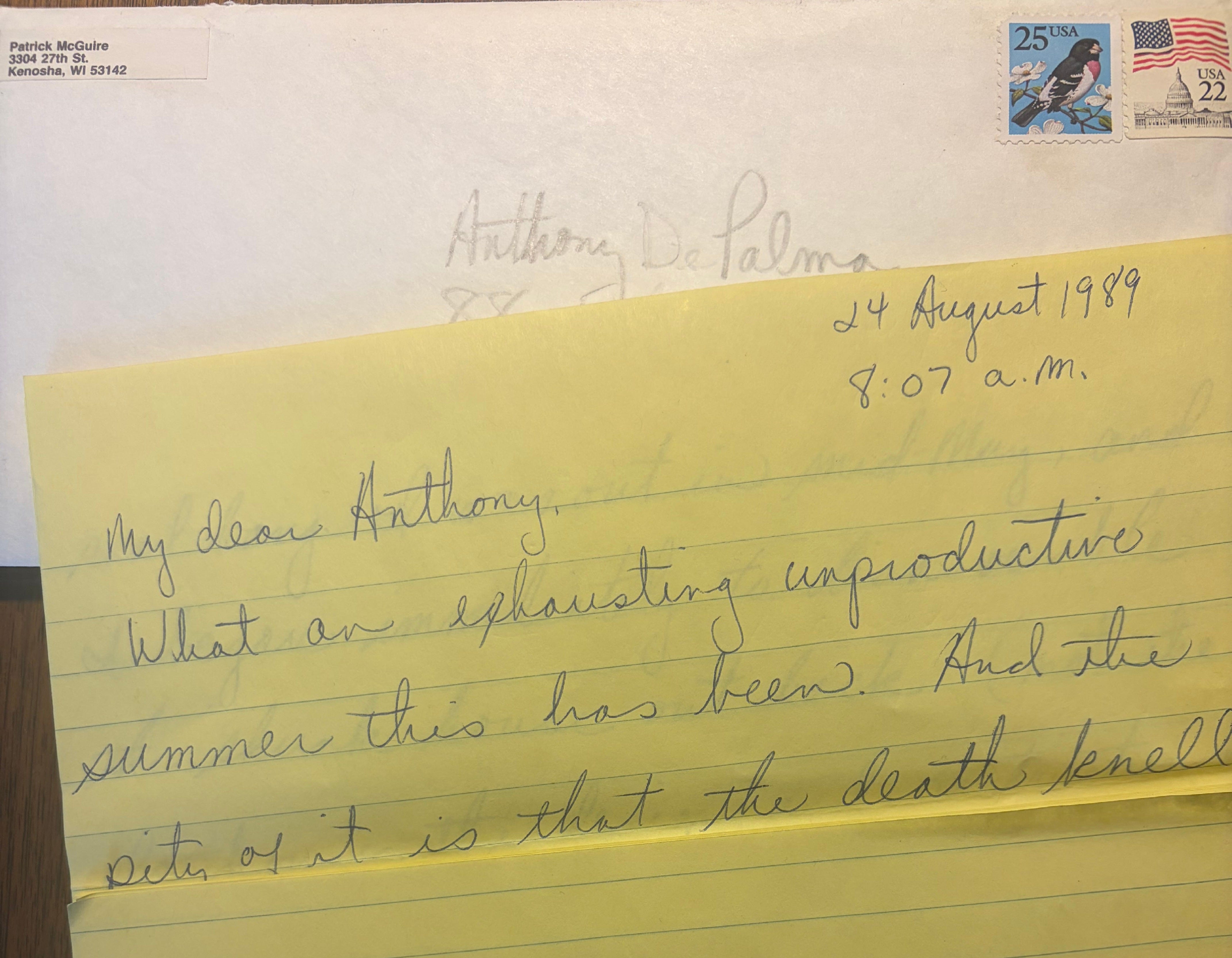
There was one more surprise in there—a letter, addressed to me and stamped but never sent. Of course I opened it. It was time-stamped 8:07 a.m. 24 of August, 1989. Unlike so much of our correspondence, this one wasn’t directly about the craft of writing as much as it was about the challenge of living. I can picture him at the table or back in his study writing in long hand on a yellow legal pad. “I’ve just dropped Anna off at school or her first day of the new school year,” he wrote. “On Monday the kids go back, and Tuesday week I go back.”
His theme was the end of summer, and his narrative covered all the ways he’d been distracted from writing. He’d disassembled the skunk house. He’d built the raised beds of his garden. Lawn mowing had grown onerous, along with weeding the grape row. The pear tree was blighted. Through all that he taught his load of summer classes. He found time to work on his short novel and was disappointed to realize he’d written into a dead end.
Five handwritten pages in, his missive took a retrospective turn. Although he could still “put on airs” so that no one but you knew how he truly felt, he wasn’t happy with himself. “It’s so tedious that some times I just tell myself to stop writing, give it up, enjoy life. But three minutes later I’m rehearsing a scene in the book in my mind or rephrasing a piece of dialogue. It never stops.”
He wasn’t sleeping well at that time, “too tired to sleep,” he said. The incessant teaching load weighed on him, and as he geared up for another semester, he felt it holding him back. It was then that he acknowledged that the tenor of the letter was overly negative. “I’m tempted not to post it, but I will,” he wrote.
He sealed it in an envelope and affixed two stamps (worth a total of 47 cents!), addressed it to me and included his return address. But he never send it. I wish he had. We were still living in New Jersey then and I like to think I would have called him on the phone the night his letter arrived. I’d have waited until the kids were asleep, and he was ensconced in his study, maybe accopmanied by a glass of spirits, and I would have talked him off the ledge. That never happened because he never mailed the letter. And he never mailed it because he was who he was. Of all the things I admired about him over the many, many long years I knew him, it was his resiliant spirit—embodied in his over-sized personality, his rash raconteur’s character, his insatiable curiosity and his immense appetite for joy—that I most envied. He dazzled me every time we were together, and I always came away wishing I could be more like him. I think he didn’t send the letter because he wanted to spare me knowing that part of him that he always kept hidden. That if I knew he felt self-doubt, it would leach into my own insecurity. He knew I needed him to be above all that so that I could go on.
In return, I sent Anna a letter thanking her the kindness she showed in collecting all of that material and sending it to me, including the letter he’d written but never sent, the letter that I read 26 years after he’d set those words to paper. I ended my own letter this way: “Most of all, I want to thank you for sharing Patrick with me these many years. It means more to me than I can say that Patrick has been, and always will be, such an important part of my life.”
Tip....your dad meant the world to me. Humbly sharing some of my thoughts about him is my way of sharing him with the world.
Thanks Lynn. I had no idea Pat had kept all those manuscripts. He also held on to several of my published articles, some for decades. It was humbling.